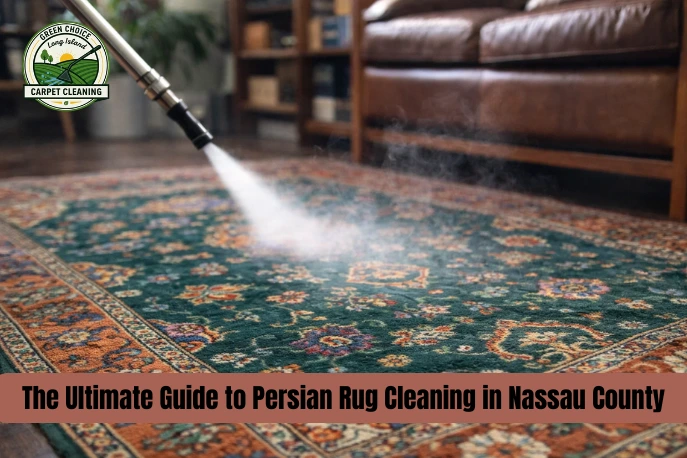
Persian rug cleaning requires specialized hand-washing techniques with pH-balanced, wool-safe solutions, controlled water temperature (never above 100°F), and proper drying to protect natural dyes and hand-knotted construction. For Nassau County homeowners, professional cleaning every 12–18 months costs $3–$7 per square foot (typically $240–$750 for common sizes) and prevents the $5,000–$50,000 damage that improper cleaning causes to these investment pieces. Never use home carpet cleaners, steam cleaners above 100°F, or harsh chemicals Persian rugs require expertise that protects both their beauty and their value.
As the owner of Green Carpet Cleaning Long Island, I’ve cleaned hundreds of Persian rugs across Nassau County from $2,000 machine-made pieces in Garden City to $80,000 antique hand-knotted Tabriz rugs in Great Neck estates. I’ve also seen the disasters that happen when people try to clean Persian rugs themselves or hire companies that don’t understand what makes these rugs different.
Let me be clear: Persian rug cleaning is NOT the same as carpet cleaning. The techniques, equipment, and solutions are completely different. If you treat a Persian rug like wall-to-wall carpet, you’ll destroy it. I’ve had clients bring me rugs with ruined colors, bleeding dyes, and damaged foundations because someone used the wrong approach.
This guide will give you everything you need to know about properly cleaning and maintaining your Persian rug in Nassau County.
What Makes Persian Rugs Different (And Why It Matters)
Before we talk about cleaning, you need to understand what you’re dealing with:
Hand-Knotted Construction Most Persian rugs are hand-knotted—each knot is individually tied by hand. A high-quality Persian rug can have 300–600 knots per square inch (some go even higher). This construction is delicate and can be damaged by aggressive cleaning or improper drying.
Natural Dyes Traditional Persian rugs use vegetable dyes—madder root for red, indigo for blue, saffron for yellow. These natural dyes are NOT colorfast like modern synthetic dyes. They can bleed, fade, or run if exposed to the wrong cleaning solutions, hot water, or harsh chemicals.
Natural Fibers Most Persian rugs are 100% wool pile with cotton foundation (warp and weft). Some use silk. Natural fibers require pH-neutral solutions and controlled moisture. Too much water, wrong pH, or improper drying can cause shrinkage, dry rot, or fiber damage.
Age Matters Antique Persian rugs (50+ years old) are even more delicate. The fibers have aged, the dyes have set differently, and the foundation may be fragile. These require extra-gentle treatment.
I had a client in Manhasset with a 1920s Heriz rug her grandmother brought from Iran. She tried cleaning it with a Rug Doctor from the grocery store. The hot water and harsh detergent caused the reds to bleed into the ivory background, creating permanent pink staining across half the rug. The damage was irreversible a $30,000 rug reduced to maybe $5,000 in value because of one bad cleaning attempt.
How Often Should You Clean Your Persian Rug?
Here’s the honest answer based on 30+ years of combined experience across our team:
| Household Type | Cleaning Frequency | Why |
|---|---|---|
| Low traffic, no pets, no kids | Every 18–24 months | Minimal soil buildup; maintenance cleaning sufficient |
| Moderate traffic, normal use | Every 12–18 months | Dirt accumulates in foundation; prevents fiber damage |
| High traffic, kids, or pets | Every 6–12 months | Frequent soil buildup and potential stains require more attention |
| Pets with accidents | Immediately + every 6 months | Urine damages natural fibers quickly; requires professional enzyme treatment |
| Antique rugs (50+ years old) | Every 12–18 months | Gentle cleaning prevents accumulated damage to fragile fibers |
| Silk Persian rugs | Every 12–18 months | Silk is delicate; requires specialized cleaning more than wool |
The single biggest mistake Nassau County homeowners make is waiting too long. They think, “The rug still looks okay, I’ll wait another year.” But by the time a Persian rug LOOKS dirty, it’s already holding 3–4 years of accumulated soil deep in the foundation. That soil is grinding against the fibers with every footstep, causing permanent damage you can’t reverse.
I tell every client: clean your Persian rug on a schedule, not based on appearance. By the time it looks dirty, the damage is already done.
Signs Your Persian Rug Needs Cleaning NOW
Don’t wait for your scheduled cleaning if you notice:
1. Colors Look Dull or Muted If the vibrant reds, blues, and golds don’t “pop” anymore, there’s a dirt film over the fibers obscuring the colors. Professional cleaning removes that film and restores the vibrancy.
2. Visible Traffic Patterns Dark pathways where people walk indicate dirt is embedded deep in the pile. This dirt is abrading the fibers right now, causing permanent damage.
3. The Rug Feels Crunchy or Stiff Dirt buildup makes wool fibers feel coarse instead of soft and supple. This means the dirt has penetrated the entire pile depth.
4. Any Odor At All Persian wool should smell clean or faintly like lanolin (natural wool oil). If it smells musty, like pets, or just “old,” there’s bacteria growth in the fibers or foundation.
5. Visible Stains or Spills Any stain wine, coffee, pet accidents, food should be professionally treated within 24–48 hours if possible. The longer it sits, the more it sets into natural fibers.
6. Moth Activity If you see moths near the rug or notice small holes appearing, you have a moth infestation. Moths are attracted to dirty wool. Immediate professional cleaning and treatment is required.
The Proper Persian Rug Cleaning Process
Here’s exactly what happens when you bring your Persian rug to Green Carpet Cleaning Long Island for proper cleaning:
Step 1: Detailed Inspection (15–30 minutes) We examine every inch of your rug under proper lighting. We’re checking for:
- Fiber type (wool, silk, or blend)
- Dye stability (will colors bleed?)
- Pre-existing damage (holes, worn areas, dry rot)
- Foundation condition (warp and weft integrity)
- Stains and their likely composition
- Moth damage or active infestation
We photograph everything and document condition before cleaning. This protects both you and us.
Step 2: Dye Testing (5–10 minutes) We test every color on your rug for colorfastness. We apply our cleaning solution to a small hidden area (usually the fringe or edge), blot with a white cloth, and check for any color transfer. If dyes aren’t stable, we adjust our cleaning approach or recommend against water cleaning entirely.
This step is non-negotiable for Persian rugs. I’ve rejected rugs for cleaning because the dyes weren’t stable and water cleaning would destroy them. Better to be honest upfront than ruin your rug.
Step 3: Dry Soil Removal (10–15 minutes) We use specialized equipment to vibrate and gently beat the rug, removing dry soil from deep in the pile and foundation. This removes 60–70% of dirt BEFORE we add water. Most companies skip this because they don’t have the equipment—we don’t.
Step 4: Pre-Treatment (15–20 minutes) We apply pH-balanced (pH 6–8), wool-safe cleaning solutions to stains and high-traffic areas. For Persian rug cleaning, we use solutions specifically formulated for natural dyes and wool fibers never the harsh alkaline chemicals used for synthetic carpets.
Step 5: Hand Washing (30–60 minutes depending on size) We hand-wash Persian rugs in our climate-controlled facility using:
- Cool to lukewarm water (70–100°F maximum never hot)
- Soft brushes that follow the pile direction
- pH-neutral solutions that won’t strip natural dyes
- Gentle agitation that cleans without damaging the knots
We NEVER use high-pressure steam cleaners or truck-mounted equipment on Persian rugs. The pressure and heat will damage natural fibers and cause dye bleeding.
Step 6: Thorough Rinsing (15–30 minutes) We rinse until water runs absolutely clear. Any soap residue left in the rug will attract dirt and make it get dirty faster. Multiple rinses ensure complete soap removal.
Step 7: Water Extraction (10–15 minutes) We use specialized extraction equipment designed for delicate rugs to remove 90–95% of water. This is critical—over-saturated rugs can develop mold, dry rot, or dye bleeding during drying.
Step 8: Climate-Controlled Drying (24–72 hours) Your rug dries flat in our temperature and humidity-controlled facility. We monitor temperature (70–75°F) and humidity (40–50%) throughout drying to prevent mold, mildew, or color bleeding. Drying time depends on the rug’s size, pile density, and foundation material.
Step 9: Final Grooming and Inspection (15–30 minutes) Once completely dry, we groom the pile to restore its natural direction and luster, inspect for any issues, and give you a post-cleaning report.
Total turnaround time is typically 7–14 days depending on our schedule and your rug’s drying time.
What Never To Do To Your Persian Rug
I’ve seen too many ruined Persian rugs in Nassau County. Here’s what NEVER to do:
❌ Never Use a Home Carpet Cleaner Those Rug Doctor, Bissell, or Hoover machines from the store? They’re designed for synthetic wall-to-wall carpet, not Persian rugs. They use hot water (130–150°F), harsh alkaline solutions (pH 10–12), and aggressive brushing that will:
- Cause dye bleeding and color running
- Damage hand-knotted construction
- Over-saturate the foundation leading to dry rot
- Strip natural lanolin from wool, making it brittle
❌ Never Steam Clean Above 100°F Heat sets stains into natural fibers and can cause irreversible dye bleeding. I’ve seen $20,000 rugs destroyed because someone used a steam cleaner at 200°F.
❌ Never Use Harsh Chemicals No bleach, no OxiClean, no Resolve, no ammonia-based products. These will strip color from natural dyes and damage wool fibers. Even products marketed as “carpet cleaners” are usually too harsh for Persian rugs.
❌ Never Scrub Aggressively The hand-knotted construction is delicate. Hard scrubbing can fray fibers, damage the weave, or create fuzzy areas that never look right again. Always blot, never scrub.
❌ Never Hang to Dry When Wet The weight of water in a wet rug can stretch and distort the foundation, causing permanent warping. Always dry flat.
❌ Never Place in Direct Sunlight to Dry UV light fades natural dyes rapidly. Dry in indirect light or controlled indoor conditions only.
❌ Never Leave Wet or Damp If a Persian rug stays damp for more than 24–48 hours, mold and mildew will grow in the foundation. This causes permanent odor and can destroy the rug’s structure.
How to Handle Spills and Stains at Home (Emergency Steps)
If you spill something on your Persian rug, here’s what to do IMMEDIATELY:
For Liquids (Wine, Coffee, Juice):
- Blot immediately with clean white towels press down firmly, don’t rub
- Work from outside in to prevent spreading
- Blot until towels come up barely damp (may take 10–15 towels)
- Do NOT add water, cleaner, or anything else
- Call us at (516) 894-2930 within 24 hours for professional treatment
For Solids (Food, Mud):
- Let it dry completely (usually 2–4 hours)
- Gently vacuum or pick up dried material
- Do NOT try to clean the stain yourself
- Call us at (516) 894-2930 for professional treatment
For Pet Accidents:
- Blot liquid immediately with white towels
- Apply cool (not hot) water to dilute, then blot again
- Do NOT use enzyme cleaners designed for synthetic carpet they can damage natural dyes
- Call us IMMEDIATELY at (516) 894-2930) pet urine damages natural fibers quickly
The key is: blot and call us. Don’t try to “fix” it yourself. I’ve seen more damage from attempted home stain removal than from the original stains.
Persian Rug Cleaning Cost in Nassau County
Let’s talk numbers. Here’s what professional Persian rug cleaning costs:
Standard Pricing: $3–$7 per square foot
| Rug Size | Square Footage | Typical Cost Range |
|---|---|---|
| 3×5 | 15 sq ft | $45–$105 |
| 5×8 | 40 sq ft | $120–$280 |
| 6×9 | 54 sq ft | $160–$380 |
| 8×10 | 80 sq ft | $240–$560 |
| 9×12 | 108 sq ft | $325–$750 |
| 10×14 | 140 sq ft | $420–$980 |
What Influences Cost:
- Fiber Type: Silk costs more than wool (30–50% premium)
- Condition: Heavy staining or pet damage adds $50–$200
- Age: Antique rugs requiring extra-gentle care cost more
- Repairs Needed: Fringe repair, binding, or foundation work is additional
We offer free pickup and delivery within 20 miles of our Baldwin location. For Nassau County homes farther out, there’s typically a $25–50 travel fee depending on distance.
Is It Worth It? Consider this: you have a Persian rug worth $5,000–$50,000. Spending $300–$700 every 12–18 months to professionally clean and protect it is like insurance. One improper home cleaning attempt can destroy value permanently.
I’d rather see you spend $500 on proper professional cleaning than lose $10,000+ in value from DIY damage.
Special Considerations for Different Persian Rug Types
Not all Persian rugs are the same. Different origins and constructions require different care:
Tabriz Rugs (Intricate Designs, Fine Knotting) These have very high knot density (300–600 KPSI) and delicate pile. They require gentler brushing and extra care during drying to prevent pile distortion.
Heriz Rugs (Geometric Patterns, Coarser Weave) More durable than Tabriz but still hand-knotted. The bolder colors (especially reds) can bleed if dyes aren’t tested properly before cleaning.
Isfahan Rugs (Silk and Wool Blend, Extremely Fine) These are museum-quality pieces requiring maximum care. Often worth $20,000–$100,000+. We hand-wash these with extra-gentle solutions and dry them with special attention to prevent any moisture-related issues.
Kashan Rugs (Floral Patterns, Medium Knot Density) Beautiful pieces with intricate floral designs. The multiple colors mean extra dye testing is critical before cleaning.
Qum Rugs (Often Silk, Very Fine) Pure silk or silk-on-silk construction. These require specialized silk rug cleaning techniques even gentler than wool cleaning.
If you don’t know your rug’s origin or type, we can identify it during our inspection. It matters because different regions use different wool quality, dye types, and knotting techniques all of which affect how we clean the rug.
Maintenance Between Professional Cleanings
To protect your Persian rug between professional cleanings:
Weekly Vacuuming (But Do It Right)
- Use suction only no beater bar or brush roll
- Vacuum in the direction of the pile, not against it
- Avoid the fringes vacuum perpendicular to fringes, not across them
- Use low suction on silk rugs high suction can pull out delicate fibers
Rotate Every 6–12 Months Rotate your rug 180° to even out wear patterns and sun exposure. This prevents one section from wearing out faster than others.
Use Rug Pads Quality rug pads protect the foundation, prevent slipping, and extend rug life. Make sure pads are wool-safe and don’t have rubber backing (rubber can stain natural fibers over time).
Avoid Direct Sunlight UV rays fade natural dyes. Use window treatments to protect rugs from direct sun, especially during peak hours (10am–4pm).
Address Stains Immediately The longer a stain sits, the more it sets into natural fibers. Blot immediately and call us within 24 hours for the best chance of complete removal.
No Shoes on the Rug Shoes track in abrasive dirt that grinds against fibers. A no-shoe policy extends rug life significantly.
Pet Owners: Special Considerations
If you have pets and Persian rugs, you need to be extra careful:
Pet Urine is Extremely Damaging The uric acid in pet urine chemically breaks down wool fibers and can cause permanent yellowing or browning. If your pet has an accident on your Persian rug:
- Blot immediately with white towels
- Rinse with cool water, blot again
- Call us at (516) 894-2930 IMMEDIATELY don’t wait even a day
Our pet stain removal service uses specialized enzyme treatments safe for natural fibers that break down uric acid without damaging wool or silk.
Pet Hair Management Regular vacuuming is essential. Pet hair and dander accumulate deep in pile and attract moths (moths are attracted to the protein in pet dander).
Consider Your Rug’s Location If you have a pet-accident-prone dog or cat, consider moving your most valuable Persian rugs to low-risk areas. Put less valuable area rugs or washable rugs in high-risk areas instead.
What About Antique Persian Rugs?
Antique rugs (50+ years old) require even more specialized care:
Fragile Foundations Cotton warp and weft threads weaken over time. Aggressive cleaning can cause tears or breaks in the foundation that are expensive to repair.
Aged Dyes Vegetable dyes that have aged for decades may be less stable than newer dyes. Extra dye testing is critical.
Historical Value An antique Persian rug isn’t just furniture it’s a piece of history. Improper cleaning can destroy not just the rug but its historical and monetary value.
We offer specialized antique rug cleaning with extra-gentle techniques designed to preserve fragile fibers and aged dyes. We’ve cleaned rugs over 150 years old—pieces that have survived this long deserve expert care.
Comparing Wool vs. Silk Persian Rugs
Wool Persian Rugs:
- More durable and forgiving
- Can handle more frequent vacuuming
- Less expensive to clean
- More common in homes with kids/pets
- Typical cleaning cost: $3–$5 per square foot
Silk Persian Rugs:
- Extremely delicate fibers can snag or pull
- Require gentle vacuuming (low suction, no brush)
- More expensive to clean
- Best kept in low-traffic, adult-only areas
- Typical cleaning cost: $5–$7+ per square foot
One client in Roslyn had a silk Isfahan rug in her formal living room a room nobody used. Even then, she had us clean it every 18 months to prevent dust accumulation. The rug was worth $45,000, so spending $800 every 18 months on cleaning was sensible protection.
Why Choose Green Carpet Cleaning Long Island?
We specialize in oriental rug cleaning and Persian rug cleaning across Nassau and Suffolk County. We’re not a general carpet cleaning company that “also does rugs” fine rug cleaning is a core part of our business.
When you call (516) 894-2930, you’re talking to us the people who will actually handle your rug. We’re based in Baldwin at 1959 Teehan Ln, and we’re invested in this community. Your Persian rug isn’t just another job to us it’s a valuable piece we treat with the respect it deserves.
We also clean:
- Wool rugs of all types
- Area rugs (any origin)
- Wall-to-wall carpet in your home
- Upholstery and fine furniture
We serve all of Nassau County, including Garden City, Great Neck, Manhasset, Roslyn, and surrounding areas.