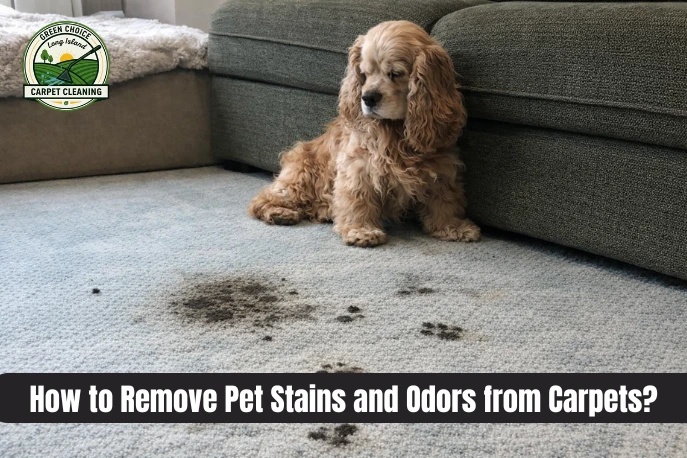
To remove pet stains and odors from carpets, blot fresh accidents immediately with white towels, apply a 50/50 mix of white vinegar and water, then use an enzyme cleaner designed for pet urine. For set-in stains or odors that reach the padding, professional steam cleaning with specialized treatments is necessary DIY methods can’t penetrate deep enough to eliminate the bacteria and enzymes causing the smell.
As the owner of Green Carpet Cleaning Long Island, I’ve dealt with every type of pet stain imaginable across Suffolk County. Dog urine on living room carpet in Huntington? Done it hundreds of times. Cat accidents that soaked through to the padding in Babylon? I’ve seen it all. Let me give you the real answer on what works, what doesn’t, and when you need to call in professionals like us.
Why Pet Stains Are Different (And Why They’re So Hard to Remove)
Here’s the thing most Long Island homeowners don’t realize: pet urine isn’t just a surface stain. When your dog or cat has an accident, the liquid soaks down through the carpet fibers, into the backing, and settles in the padding underneath. That’s typically 1/2 to 3/4 inch deep.
Your carpet might look clean on the surface after you scrub it, but the urine crystals and bacteria are still living in the padding. That’s why the smell comes back especially on humid Long Island summer days when the heat reactivates those crystals.
I’ve had clients in Bay Shore call me saying, “I’ve shampooed this spot ten times and it still smells like dog.” Of course it does they’re cleaning the surface while the real problem is underneath where home equipment can’t reach.
The Immediate Action Plan (For Fresh Accidents)
If you catch the accident right away within the first few minutes here’s exactly what to do:
Step 1: Blot, Don’t Rub Use white towels or paper towels and press down hard to absorb as much liquid as possible. Don’t rub or scrub that just pushes the urine deeper into the carpet fibers. Keep blotting until the towels come up mostly dry. I’ve seen homeowners remove 70–80% of the urine just from aggressive blotting.
Step 2: Apply Vinegar Solution Mix equal parts white vinegar and water in a spray bottle. Saturate the area (yes, really saturate it you need to reach the depth the urine went). Let it sit for 5–10 minutes, then blot again. The vinegar neutralizes the ammonia in pet urine.
Step 3: Use an Enzyme Cleaner This is non-negotiable. Regular carpet cleaners won’t work. You need an enzyme-based pet stain remover (Nature’s Miracle, Rocco & Roxie, Simple Solution any of these work). The enzymes break down the uric acid crystals that cause the smell. Pour it on generously, let it sit for 10–15 minutes, then blot dry.
Step 4: Rinse and Dry Spray the area with plain water to rinse out the cleaner, blot again, then place a fan over it to dry completely. This usually takes 4–6 hours.
If you do all of this within 10–15 minutes of the accident, you’ve got maybe a 70% chance of removing the stain and odor completely. But if the accident happened hours ago, or if your pet has hit the same spot multiple times? You’re going to need professional help.
Why DIY Methods Fail on Set-In Stains
I’m going to be straight with you: if the stain is more than a few hours old, or if your pet has repeatedly soiled the same area, home cleaning methods won’t fully work. Here’s why.
Home carpet cleaners don’t have enough suction. That Bissell or Hoover you rented from the grocery store? It pulls out maybe 60–70% of the water you put in. Our professional equipment extracts 95–98%. That remaining 30–40% of dirty water just sits in your padding and re-soils the carpet as it dries.
You can’t get the water hot enough. Pet urine bacteria dies at 160–180°F. Your home machine heats water to maybe 120–130°F at best. Our steam carpet cleaning equipment reaches 200°F+, which actually kills the bacteria causing the odor.
Enzyme cleaners need time to work. When we do pet stain removal, we pre-treat stains with commercial-grade enzyme solutions and let them dwell for 20–30 minutes before cleaning. Most homeowners spray and scrub immediately, which doesn’t give the enzymes time to break down the uric acid.
The padding holds the odor. Once urine reaches the carpet padding, it’s game over for DIY. The padding is like a sponge it absorbs and holds onto urine, and there’s no way to clean it without pulling up the carpet. We use sub-surface extraction tools that inject cleaning solution into the padding and pull it back out. You can’t do that with a home machine.
I had a client in Commack who spent $200 on rental machines and cleaning products over three months trying to remove dog urine smell from her hallway. She finally called us. We spent 45 minutes on that hallway with our equipment and eliminated the odor completely. She could’ve saved $150 and months of frustration by calling us first.
The Professional Approach (What We Do Differently)
When someone calls Green Carpet Cleaning Long Island at (516) 894-2930 for pet stain issues, here’s our process:
1. UV Light Inspection We use a UV blacklight to find every spot your pet has ever hit even ones you didn’t know about. Pet urine glows under UV light. I’ve shown homeowners 15–20 spots they had no idea existed. You can’t treat what you can’t see.
2. Enzyme Pre-Treatment We apply commercial-grade enzyme solutions to every affected area and let them dwell for 20–30 minutes. This breaks down the uric acid crystals that cause odor. Then we agitate the area with a brush to work the solution into the carpet backing.
3. High-Temperature Steam Extraction Our truck-mounted equipment heats water to 200°F+ and delivers 500+ PSI of pressure. This combination kills bacteria, dissolves stains, and extracts everything dirt, urine, enzymes, bacteria from deep in the carpet and padding. We make multiple passes over each affected area.
4. Sub-Surface Treatment (For Severe Cases) If the urine has saturated the padding (which happens when pets repeatedly hit the same spot), we use specialized tools that inject enzyme solution directly into the padding, let it dwell, then extract it. This is the only way to truly eliminate odor from deep contamination.
5. Deodorizer Application After cleaning, we apply a professional-grade deodorizer that neutralizes any remaining odor molecules and leaves a fresh, clean scent. Not that fake “pet smell covered up with perfume” smell actually clean.
6. Speed Drying We extract so much water that carpets are typically dry in 4–6 hours instead of 24–48 hours with rental machines. Faster drying means less risk of mold or mildew in our humid Long Island climate.
Common Mistakes Long Island Pet Owners Make
Mistake #1: Using Steam Cleaners on Fresh Stains Heat sets protein-based stains like pet urine. If you use a steam cleaner or hot water on a fresh accident before treating it with enzymes, you’re literally cooking the urine into the carpet fibers. Always use cold or lukewarm water initially.
Mistake #2: Scrubbing Hard Aggressive scrubbing damages carpet fibers and pushes the stain deeper. Blot, don’t scrub. Use downward pressure, not circular motion.
Mistake #3: Not Using Enough Product Pet owners are too conservative with enzyme cleaners. You need to saturate the area to the same depth the urine went. If your dog left a dinner-plate-sized wet spot, you need to pour a cup or more of enzyme cleaner on it.
Mistake #4: Covering the Spot Too Soon Don’t put furniture back or walk on the area until it’s 100% dry. Damp carpet attracts dirt and can develop mold in our humid climate.
Mistake #5: Using the Wrong Products Never use ammonia-based cleaners on pet urine. Ammonia smells like urine to pets and actually encourages them to urinate in the same spot again. Only use pet-specific enzyme cleaners.
Mistake #6: Ignoring the Problem Some homeowners think if they ignore old accidents, the smell will fade on its own. It won’t. Uric acid crystals are incredibly stable they can last years. And every humid day reactivates them. The only way forward is proper treatment.
When to Call Green Carpet Cleaning Long Island
Call us at (516) 894-2930 if:
- The odor comes back after cleaning (means it’s in the padding)
- Multiple accidents have happened in the same area
- The stain is more than a week old
- You’ve tried DIY methods and they didn’t work
- Your pet has soiled a large area (bigger than 2×2 feet)
- You’re selling your home and need carpets to look and smell perfect
- You just want professionals to handle it (sometimes peace of mind is worth the call)