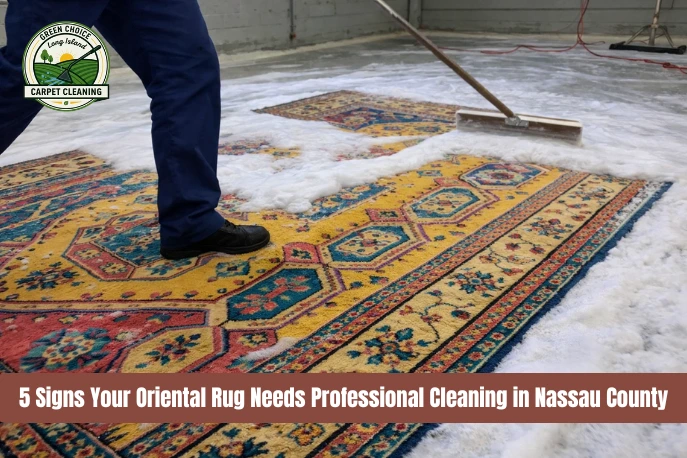
Your oriental rug needs professional cleaning if you notice: Visible dirt in traffic patterns even after vacuuming, Colors looking dull or faded, Persistent odors that won’t go away, Visible stains or spills that have set in, or it’s been more than 12–18 months since the last cleaning. Waiting too long damages the delicate fibers and can permanently dull the colors that make oriental rugs valuable.
As the owner of Green Carpet Cleaning Long Island, I’ve cleaned hundreds of oriental rugs across Nassau County Persian rugs in Garden City living rooms, antique Turkish rugs in Manhasset estates, hand-knotted pieces in Great Neck homes. I’ve seen what happens when owners wait too long, and I’ve seen the dramatic difference proper cleaning makes. Let me give you the straight answer on when your oriental rug is telling you it needs professional attention.
Sign #1: Traffic Patterns You Can Actually See
This is the most obvious sign, but homeowners often ignore it longer than they should. If you can see visible pathways where people walk areas that look darker, grayer, or just “dirtier” than the rest of the rug that’s your rug screaming for help.
Here’s what’s happening: dirt particles act like sandpaper on rug fibers. Every time someone walks across that high-traffic area, those particles grind against the wool or silk, breaking down the fibers and dulling the colors. The dirt you’re seeing on the surface? That’s maybe 20% of what’s actually there. The other 80% is embedded deep in the pile where your vacuum can’t reach.
I had a client in Roslyn with a beautiful Persian rug in her entryway. She vacuumed religiously twice a week but never had it professionally cleaned. After five years, the traffic pattern was so worn down that the rug looked like it had two different colors the walked-on areas were gray-brown, the edges were still vibrant red and blue. When we cleaned it, we restored maybe 70% of the original color, but some of the fiber damage was permanent.
Don’t let that be your rug. If you can see traffic patterns, call us at (516) 894-2930 before the damage becomes irreversible.
Sign #2: The Colors Look Dull or Faded
Oriental rugs are investments some of my Nassau County clients have rugs worth $5,000–50,000 or more. The value is largely in those rich, vibrant colors. When colors start looking dull, lifeless, or faded, most people assume it’s from sun exposure or age.
Sometimes that’s true. But 80% of the time? It’s from dirt buildup creating a film over the fibers that makes colors look muted. Think of it like looking through a dirty window the view is still there, it’s just obscured.
When we do oriental rug cleaning for clients who haven’t cleaned their rugs in 3–5 years, the transformation is dramatic. Colors that looked brownish-red suddenly become vibrant crimson. Blues that looked muddy become deep navy. It’s like seeing the rug for the first time again.
One client in Mineola thought her 40-year-old Persian rug had just “aged.” She was considering replacing it. We cleaned it, and the colors came back so vibrantly she couldn’t believe it was the same rug. She sent us photos to show her family that’s how dramatic the difference was.
If your rug’s colors don’t “pop” anymore, it’s not age. It’s dirt. And professional cleaning will bring them back.
Sign #3: Odors That Won’t Go Away
This is especially common in Nassau County homes with pets or high humidity. If your oriental rug has a musty smell, a pet odor, or just a general “old rug” smell that doesn’t go away even after vacuuming, you’ve got bacteria and possibly mold growing in the fibers or foundation.
Oriental rugs are made from natural materials wool, silk, cotton. These materials absorb moisture from our humid Long Island summers, from pet accidents, from spills that weren’t fully cleaned up. Once moisture gets into the foundation (the cotton backing most oriental rugs have), bacteria and mold start growing. You can’t vacuum that away or spray it away with Febreze.
I’ve cleaned rugs in Westbury homes where the owner swore there were no pet accidents, but our UV light inspection showed 15+ spots of urine contamination. Pets sometimes sneak onto rugs when you’re not home, or accidents happened years ago and were never properly treated. The smell lingers forever unless you use professional pet stain removal techniques designed for delicate fibers.
Musty smells are even more concerning because that usually means mold or mildew in the foundation. This requires specialized cleaning with controlled drying to prevent water damage to the rug’s structure.
We had a client in Port Washington whose antique Tabriz rug smelled musty for two years. She assumed it was just “old rug smell.” We cleaned it, found mold in the cotton foundation from a humidifier that had been placed too close, treated it with antimicrobial solutions, and dried it properly in our climate-controlled facility. The smell never came back.
If you smell anything on your oriental rug, that’s a sign bacteria or mold is present. Don’t wait call us before it damages the rug permanently.
Sign #4: Visible Stains or Spills That Have Set In
Red wine on a cream-colored Persian rug. Coffee on an antique silk runner. Kids’ juice boxes on a hand-knotted Kashan. I’ve seen every type of stain imaginable on oriental rugs across Nassau County.
Here’s the thing about stains on oriental rugs: they’re not like carpet stains. These rugs often have natural dyes that can be damaged by common household stain removers. That bottle of Resolve you use on your carpet? It can strip color from an oriental rug or cause dye bleeding that ruins the entire piece.
When clients try to remove stains themselves, I see three common disasters:
Over-wetting the rug: They pour water or cleaner on the stain, soak it, and don’t dry it properly. This causes dye bleeding, where colors from one area run into another. A red stain becomes a red stain surrounded by a pink halo that spreads across multiple colors. This is often irreversible.
Using the wrong products: Bleach-based cleaners, harsh chemicals, or even some “natural” solutions can damage natural dyes or the wool fibers themselves.
Scrubbing too hard: Oriental rug fibers are more delicate than regular carpet. Aggressive scrubbing can fray fibers, damage the weave, or create fuzzy areas that never look right again.
If you have a stain on your oriental rug, DO NOT try to remove it yourself unless it’s fresh water (and even then, just blot, don’t rub). Call us immediately at (516) 894-2930. We have specialized stain removal techniques for oriental rugs that protect the dyes and fibers while removing the stain.
The longer a stain sits, the harder it is to remove. I’ve had clients call me weeks or months after a spill, and by then the stain has oxidized or set into the fibers so deeply that complete removal is impossible. Call us the same day if possible.
Sign #5: It’s Been More Than 12–18 Months Since the Last Cleaning
Even if your oriental rug looks clean, if it’s been over a year since professional cleaning, it needs attention. This is the most ignored sign, but it’s the most important for long-term preservation.
Oriental rugs are not like wall-to-wall carpet. They’re heirlooms, investments, pieces of art. Proper maintenance requires professional cleaning every 12–18 months, or more frequently if you have pets, kids, or high foot traffic.
Why this timeline? Because dirt accumulation is happening whether you see it or not. Vacuuming removes surface dirt maybe the top 1/8 inch of the pile. But oriental rugs can have pile heights of 1/2 inch or more, plus the foundation beneath. Dirt, dust, skin cells, pollen (and we get tons of pollen here on Long Island), pet dander all of it sinks to the base of the pile and into the foundation.
After 12–18 months, this buildup starts causing problems:
Fiber damage: Dirt acts as an abrasive, breaking down wool or silk fibers with every footstep Color dulling: The dirt film makes colors look faded Attracting more dirt: Dirty fibers attract more dirt it compounds over time Moth damage: Moths are attracted to dirty wool rugs and lay eggs in areas with organic buildup Accelerated wear: Rugs that should last 50+ years wear out in 15–20 years
I can always tell when a client shows me a rug that hasn’t been cleaned in 3–5 years. The fibers feel different coarser, drier, less supple. Colors are muted. And often there’s dry rot starting in the foundation that the owner didn’t even know about.
One client in Hewlett had a Persian rug that was a family heirloom passed down from her grandmother. She’d never had it cleaned in 12 years of ownership. When we picked it up for Persian rug cleaning, we found the foundation had dry rot in several areas from accumulated dirt and moisture. We were able to save it, but it required foundation repair work that cost an extra $800. If she’d been cleaning it annually, that damage never would have happened.
Don’t wait for your rug to look dirty. Schedule regular professional cleaning as preventive maintenance, just like you change your car’s oil before the engine seizes.
What Happens During Professional Oriental Rug Cleaning?
I get this question constantly, especially from Nassau County clients with expensive rugs who are (rightfully) protective of their investments. Here’s our process at Green Carpet Cleaning Long Island:
1. Inspection We examine every inch of your rug for pre-existing damage, stains, wear patterns, moth damage, dye stability, and fiber type. We test dyes to ensure they won’t run during cleaning. This step is critical we’ve rejected rugs that other companies would clean but that we knew would be damaged by water.
2. Dusting We use specialized equipment to vibrate and beat the rug (gently), removing dry soil from deep in the pile and foundation. This typically removes 60–70% of the dry dirt before we even add water. Most companies skip this step because they don’t have the equipment. We don’t.
3. Pre-Treatment We apply pH-balanced, wool-safe cleaning solutions to stains and high-traffic areas. For antique rug cleaning, we use even gentler solutions designed for fragile, aged fibers.
4. Hand Washing We hand-wash oriental rugs in our facility never in your home. We use soft brushes, controlled water temperature, and gentle agitation. For delicate silk rug cleaning, we use even more careful techniques to protect the fibers.
5. Thorough Rinsing We rinse until the water runs completely clear. Any soap residue left in the rug will attract dirt and make it get dirty faster.
6. Water Extraction We use specialized equipment to remove 95%+ of the water from the rug. This is critical for preventing dye bleeding, mold growth, or foundation damage.
7. Climate-Controlled Drying Your rug dries flat in our temperature and humidity-controlled facility. We monitor it throughout the drying process to ensure no issues develop. Drying typically takes 24–48 hours depending on the rug’s size and thickness.
8. Final Grooming Once dry, we groom the pile to restore its natural direction and luster, then do a final inspection before returning it to you.
We also offer wool rug cleaning and area rug cleaning for any other fine rugs in your home.
Why You Can’t Clean Oriental Rugs at Home
I’ll be blunt: attempting to clean an oriental rug at home with a rental machine or steam cleaner is one of the worst things you can do. Here’s why:
Over-wetting causes dye bleeding. Home machines can’t control water temperature or pressure well enough for delicate rugs. I’ve seen rugs worth thousands of dollars ruined because colors bled together.
Soap residue attracts dirt. Home machines don’t rinse properly. The soap left behind acts like a magnet for dirt, making your rug get dirty faster.
Foundation damage. If you don’t dry the rug properly (which you can’t do at home), moisture sits in the cotton foundation and causes rot, mildew, or mold.
Fiber damage. The harsh chemicals in consumer carpet cleaners can strip natural oils from wool, making it dry, brittle, and prone to breaking.
Color stripping. Some rug dyes especially natural vegetable dyes used in antique pieces are not colorfast. Standard cleaning solutions can literally strip the color out.
I’ve had multiple clients call me after attempting home cleaning, needing me to repair dye bleeding or re-dye areas they damaged. The repair costs are always higher than what professional cleaning would have cost in the first place.
Oriental rugs require specialized equipment, knowledge, and techniques. This isn’t carpet it’s art. Treat it that way.
How Much Does Professional Oriental Rug Cleaning Cost?
Typical pricing for oriental rug cleaning in Nassau County runs $3–$7 per square foot depending on the rug’s condition, fiber type, and complexity.
Examples:
- 5×8 rug (40 sq ft): $120–$280
- 8×10 rug (80 sq ft): $240–$560
- 9×12 rug (108 sq ft): $325–$750
Silk rugs, antique rugs, or rugs needing stain removal or repairs cost more. But consider this: that $300–500 cleaning protects a rug that might be worth $5,000–$20,000. It’s like getting insurance on your car you’re protecting the investment.
We offer free pickup and delivery within 20 miles of our Baldwin location at 1959 Teehan Ln. For Nassau County locations farther out, there’s usually a small travel fee ($25–50 depending on distance).
Why Choose Green Carpet Cleaning Long Island for Your Oriental Rug?
We’re not a franchise. We’re a local Long Island business that’s been cleaning oriental and fine rugs for years. When you call (516) 894-2930, you’re talking to us the people who will actually handle your rug.
We also offer:
- Upholstery cleaning for your fine furniture
- Residential carpet cleaning for your wall-to-wall carpets
- Steam carpet cleaning for deep cleaning
- Organic carpet cleaning if you prefer eco-friendly solutions
We serve all of Nassau County and Suffolk County. Whether you’re in Garden City, Great Neck, or anywhere else, we’ll pick up your rug, clean it properly in our facility, and return it looking like new.